
Part of the GEO Hub This guide is one chapter of Cited's Generative Engine Optimization hub: the three-layer GEO Stack, eight strategies that hold up in 2026, and a marketer's 90-day plan.
A clean traffic chart can hide a worse week. If a buyer sees three vendor names in ChatGPT, Claude, or Gemini before they ever open your site, the shortlist is already forming without you.
AI share of voice is the share of relevant buyer prompts in which your brand appears, is recommended, or is placed first inside AI answers. In B2B software, it is a buyer-stage metric, not just an SEO metric, because the evaluation often happens inside the answer layer before a visit is even considered.
When AI share of voice beats rank tracking, and when it does not
AI share of voice matters most when the prompt can end in a shortlist. Rank tracking still matters when the assistant is mostly defining the category or teaching the buyer the basics, but it is not the best read on whether your brand enters the recommendation set. Use it to separate category education from decision-stage visibility, because those are different jobs and they do not move together.
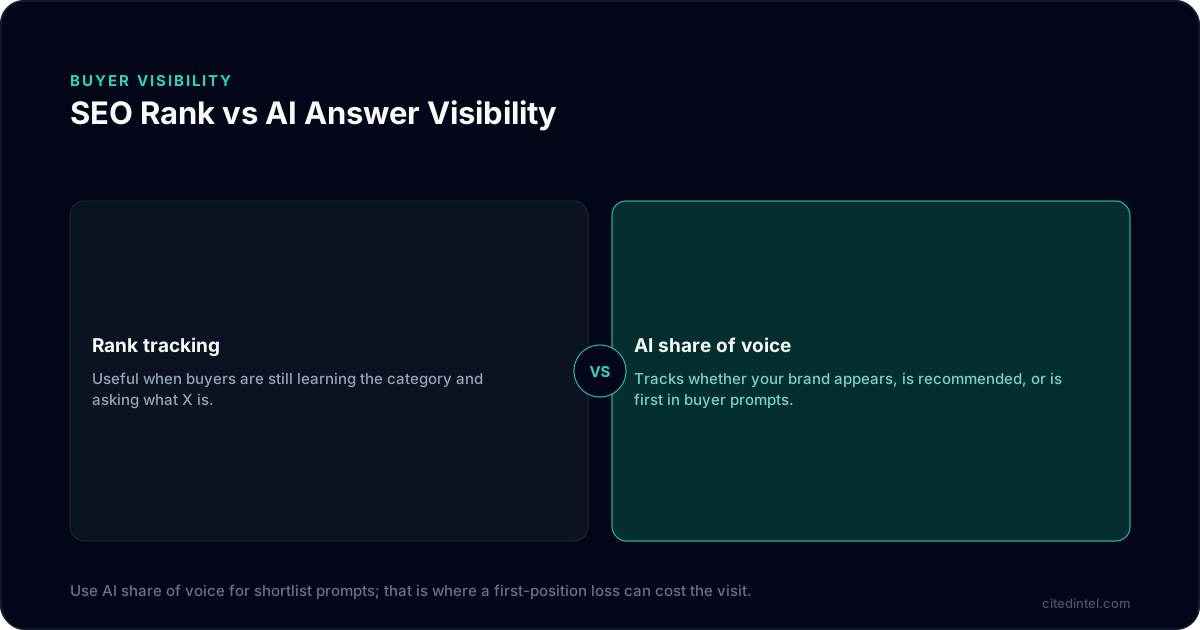
When the prompt includes a buying constraint, a comparison, or “best for” phrasing, rank tracking is already late. If the prompt is still “what is X,” keep SEO in the mix and treat AI share of voice as a secondary signal.
AI answer visibility and generative engine optimization are now practical buying terms, not just new labels for old SEO. Answer engine optimization is the same problem from the buyer’s side, with the answer layer doing work the page layer used to own. If you want a working definition, ask whether the page can be quoted in a buying answer without extra interpretation.
Use AI share of voice as a gate only for prompt families with shortlist intent. Informational prompts can still matter for discovery, but they should not trigger panic. Evaluative prompts are where a weak first-position rate becomes the first visible warning, so split your prompt list before you start drawing conclusions.
How the evidence points to answer-layer risk
AI is already inside mainstream search behavior, and that changes what you should measure. Pew Research Center found lower clickthrough when Google showed an AI summary, based on 68,879 unique searches from 900 U.S. adults collected April 7 to 17, 2025 (Pew Research Center, July 2025).
Pew also reported that 65% of adults in the United States at least sometimes encounter AI summaries in search results, and 45% say they see them extremely often or often, in its October 2025 survey (Pew Research Center, October 2025). In June 2026, Pew said 60% of U.S. adults say they ever read AI summaries at the top of search results (Pew Research Center, June 2026).
B2B buyers are moving too. Forrester said 94% of B2B buyers are using AI, and in its 2025 survey twice as many buyers named generative AI or conversational search as a more meaningful or important source of information than any other source (Forrester, 2025). Gartner has separately said B2B buyers are increasingly turning to generative AI to gather information for technology purchase consideration, which is why AI search optimization belongs in the buying stack, not just the SEO stack (Gartner, 2025).
For B2B software teams, the first competitive loss often happens in the answer layer. A PMM at a vertical SaaS company can rank well and still lose the shortlist if an AI answer keeps naming two other vendors first. The useful internal question is whether the page supplies a comparison cue, a fit cue, or a proof cue the model can reuse.
How to measure AI share of voice without fooling yourself
AI share of voice is a weighted presence score across a fixed prompt set. The point is not mathematical elegance, it is comparability: you want a repeatable read on whether your brand is entering the answer layer more often, and in stronger positions, over time. Keep the prompt set built around the same intent buckets so the score reflects content changes, not prompt drift. If the same family is scored the same way each cycle, you can tell whether a page change moved the answer or just moved the wording.
A simple formula that works
Use this formula as the audit anchor:
AI share of voice = weighted brand score / maximum possible weighted score
Keep the prompt set stable for at least one review cycle, then change only one variable at a time. If you change the prompts, the assistant mix, and the scoring rule in the same month, the metric becomes theater.
Here is a practical scoring setup:
- First choice: 2 points.
- Plain mention: 1 point.
- Absent: 0 points.
- Prompt weight: multiply by 1.0 for first position, 0.75 for second, 0.5 for later mentions.
Run that structure in one assistant, then compare the same prompt family each month. Record the prompt, the assistant, your position, and the top competitor named so the score can be traced back to a real answer pattern, not a vanity score.
Decision rule: treat any prompt family with below 30% first-position rate as repair work. If you are mentioned but not first on comparison prompts, you do not have a volume problem. You have a proof problem.
Across audits run on Citedintel as of August 2026, 58% of surfaced brands showed up only once, 4,152 distinct brands appeared across 8,353 AI answers, and the top category name appeared in 25% of responses. That long tail is the practical reason AI share of voice matters: most brands are visible, but not repeatable.
McKinsey’s 2025 AI Discovery Survey says AI-powered search has become the primary and preferred source of insight for a large share of users, and in many cases a brand’s own site supplies only 5% to 10% of the sources AI search references (McKinsey, 2025). That makes third-party mentions, review ecosystems, and clean comparison pages matter more than old-school rank obsession.
What actually moves AI share of voice
AI answers reward pages that make the category easy to compare, the proof easy to cite, and the fit easy to explain. The fastest gains usually come from fixing the page type the assistant can quote, not from publishing more posts. The page has to carry the comparison, the use case, or the constraint in language the model can reuse without guessing.
CRM: comparison pages and category definition pages
A CRM challenger tends to move when it has a plain category page, an alternatives page, and a comparison page that names the buyer’s real constraint. A broad feature page can rank well and still miss “best CRM for founder-led sales teams” prompts.
The fix is usually a side-by-side buyer page, a concise use-case page, and a short implementation page that states who the product fits and who it does not. That gives the answer engine something specific to repeat.
Payments infrastructure: regional proof and constraint pages
Payments brands move when they publish pages tied to rails, regions, and operational constraints. A generic “global payments” page may get ignored when the prompt asks about India, the UAE, or Southeast Asia.
Regional specificity beats broad claims almost every time in AI search. If your page says how settlement, compliance, or orchestration works in one market, the assistant has a reason to cite you there. A market page that names the local constraint gives the model a citation hook a generic global page never will.
Cybersecurity: validation and framework pages
Cybersecurity is where vague positioning dies fast. A vendor can have strong product pages and still miss because the assistant wants validation language, framework alignment, and a clear explanation of where the tool fits in the stack.
The proof asset is often a compliance mapping page, a buyer checklist, or a neutral mention from a credible publication. That is where answer engine optimization becomes concrete: the model needs a reason to trust the recommendation, not just a reason to name the vendor.
| Category | Before | After | Proof asset | Observable change |
|---|---|---|---|---|
| CRM | Generic feature page | Comparison page plus use-case page | Side-by-side buyer guide | More mentions in comparison prompts, better first-position rate in shortlist prompts |
| Payments infrastructure | Global claims page | Regional support and rails page | Market-specific landing page | Higher placement in country-specific prompts |
| Cybersecurity | Feature-led product page | Framework and validation page | Compliance mapping and neutral proof | More recommendation slots in evaluative prompts |
That same pattern shows up in martech, devtools, logistics tech, and healthcare SaaS. If the buyer asks a concrete question, the answer engine wants concrete proof, so the page that wins is usually the one that names the constraint, the fit, and the tradeoff in one place.
Why position matters more than raw mention rate
A mention is not the same as a recommendation. If your brand appears at the bottom of an answer, you have presence, but you do not necessarily have shortlist power.
Teams often let reporting go soft here. A mention-rate gain can look good in a dashboard while a competitor still owns the first recommendation slot.
For a B2B SaaS company, the practical use is simple. If the assistant keeps naming two vendors before yours in “best X for Y” prompts, the issue is not traffic volume. It is category memory.
Regional gaps can hide in plain sight. A brand can look strong in the US and UK, then disappear in India or the UAE because the answer layer prefers different proof, different terminology, or different regional references. The same prompt can produce a different shortlist in different markets, which is why AI search optimization has to be checked by market when the category is international.
Gartner’s 2026 Composable Buyer Journeys framing says buying teams now include humans and AI agents acting as “machine customers,” which is a strong reason to make machine-readable proof part of your content plan (Gartner, 2026). That is another way of saying the buyer is no longer the only reader that matters.
How to read the number with enough discipline to act on it
AI share of voice is useful only if you read it in context. A high score on definition prompts does not matter much if the brand is absent from shortlist prompts. A low score in one assistant does not matter much if the same pattern does not repeat across the engines that matter in your category.
Use three decision rules:
- Prompt rule: only count buyer-intent prompts with a shortlist or comparison cue.
- Assistant rule: compare results across at least four assistants, not one.
- Repair rule: if first-position rate stays below 30% in a key prompt family, rewrite the page that should own that answer.
At the page level, GEO and AEO converge on the same job: make one asset eligible to appear and easy to quote. GEO helps the brand show up in more AI results, and AEO helps it win the answer position buyers actually read. The useful test is whether the page can be quoted, not whether it can be indexed.
A limitation worth naming: AI share of voice is weaker in messy, highly fragmented categories where the assistant is still learning the space and prompt language is inconsistent. In those cases, treat it as directional, not a board metric.
Across markets, the question should be asked locally. A UK buyer asking about procurement software, an India buyer asking about logistics tech, and a UAE buyer asking about payments infrastructure may produce different answer sets from the same assistant, so one global score can hide regional gaps.
Measure your share of voice today
Use this if you need a fast read on whether the category is drifting away from you.
- Write 10 prompts in this format: “best [category] for [use case],” “alternatives to [competitor] for [constraint],” and “compare [category] vendors for [region or team type].”
- Run those prompts in your tracked assistants.
- In a sheet, capture: prompt, assistant, your brand mentioned yes or no, your position, and the top competitor named.
- Score each row 2 for first recommendation, 1 for mention, 0 for absent.
- Flag any prompt family where you are absent in three of four assistants. That is the page to fix first.
Need the fuller workflow? See why Citedintel exists or start with /start.
What this metric should change in your planning
AI share of voice should change what you prioritize, not just what you report. If it is falling in comparison prompts, the fix is usually a better alternatives page, a sharper category definition, or stronger proof. If it is rising in broad prompts but not in shortlist prompts, your content is too general. Use the score to decide which page type needs repair first, then recheck the same prompt family.
AI search optimization belongs inside category management, demand capture, and brand control. Brands that surface early in the buying process have a cleaner shot at shaping the shortlist, even when the buyer never clicks a result.
For a PMM, the question is not “are we ranking.” It is “are we the brand the answer keeps choosing?” For a content lead, it means the brief should be written around the exact prompt, not the keyword. For a founder, it means the market may already be deciding before sales knows the deal exists.
AI share of voice earns its place in GEO and AEO reviews alike. In practice, it turns an abstract visibility debate into a decision about which pages deserve repair first, starting with the prompt families where you are already being compared.
Frequently asked questions
What is AI share of voice?
AI share of voice is the percentage of relevant buyer prompts in which your brand is mentioned, recommended, or placed first in AI answers. It is a prompt-level visibility metric for how often you appear in the shortlist buyers see inside assistants like ChatGPT, Claude, and Gemini. The article argues that this is more useful than traditional rank tracking because it measures the answer layer, not just the search results page.
How do you measure AI share of voice?
Start with 20 to 50 buyer-intent prompts, run them across the assistants that matter, and score each answer for mention, position, and recommendation role. Then calculate your weighted brand score as a share of the total possible score. The article recommends tracking mention rate and first-position rate separately so you can see whether you are merely present or actually leading.
Why does first position in an AI answer matter so much?
Because the first name in an AI answer often becomes the default shortlist option the buyer remembers. The article compares the answer layer to compressed shelf space, where there may only be room for a few named vendors and one framing sentence. In that environment, being mentioned is not the same as being chosen.
What kinds of prompts should I include in an AI search optimization audit?
Use prompts that match real buying intent, such as best-of queries, comparisons, alternatives, use-case questions, and implementation questions. The article recommends focusing on the exact language buyers use when shortlisting vendors rather than broad topical queries. That makes the results far more actionable for content and positioning work.
What usually improves AI share of voice?
The article says AI answers tend to reward clarity, comparison-friendly content, and proof that is easy to source. In practice, that means stronger category definitions, more specific use-case pages, and better comparison pages. Teams that make their positioning easier for models to repeat usually improve their visibility over time.
Which AI search analytics should leadership actually see?
Three numbers cover it: share of voice on unbranded buying prompts, position within the answers you appear in, and the trend of both since last quarter. That is the AI search analytics layer worth a leadership slide. Deeper AI search monitoring, per-prompt wins and losses and source-level diagnosis, belongs with the team doing the AI SEO work, not the boardroom.