
A PM typing “best product analytics tool” may never reach your site. Before a click, the shortlist can already be forming inside AI assistants, and the winner is often the vendor with the clearest public proof in public pages, docs, and pricing.
Product analytics tools earn AI search optimization when their public pages make instrumentation, fit, and pricing easy to verify. Generative engine optimization, often searched as AI SEO, and answer engine optimization point to the same page-level job: get mentioned, then make the public proof strong enough that AI answers can repeat it without guessing or inventing setup details.
What happens when a PM asks AI what to instrument
Buyers rarely start with product names. They start with a job, activation, retention, trial conversion, or feature adoption, and they want the recommendation folded into the answer, with the tradeoff visible in the same sentence.
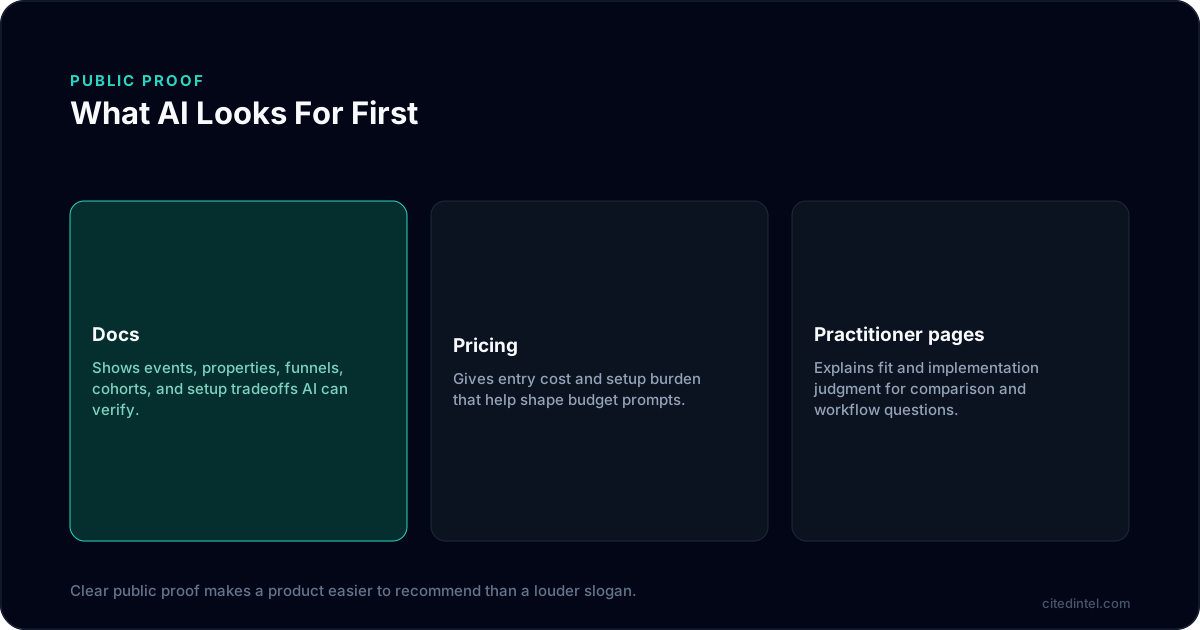
Generic homepage language usually loses that contest. If your public material does not show how you think about events, properties, funnels, cohorts, and implementation tradeoffs, the assistant has less to cite and more room to choose a rival.
For product analytics, AI search optimization starts as a documentation problem with a positioning problem attached. The brand that explains events, properties, and setup tradeoffs cleanly tends to be easier to recommend than the brand with the loudest slogan, because the model can map that language to a real implementation task.
The prompt shapes usually split three ways:
- Comparison prompt: “Amplitude vs Mixpanel for B2B SaaS” asks for fit and tradeoffs.
- Budget prompt: “Best free product analytics tool” asks for entry cost and setup burden.
- Workflow prompt: “What should we instrument first” asks for implementation judgment.
Those prompts ask for different evidence. Collapsing them into one page strategy often leaves visibility on the table, even when the same product could have earned it with separate proof for fit, cost, and setup.
AI answers prefer vendors that are easiest to specify
Answer engines tend to favor product analytics vendors that are easy to describe in plain business terms. The public page has to make stage, setup effort, and reporting style obvious enough that a model can place the tool in the right answer without pulling from a sales deck or guessing at the implementation lift.
The practical side of generative engine optimization is reducing ambiguity. Ask whether a buyer can tell, from public pages alone, what stage the tool serves, how much setup it requires, and what kind of reporting it emphasizes. If not, the assistant has to guess, and guesswork is where rivals win, because the model needs a stable public signal before it can name a product confidently or explain why it fits.
Docs do the heavy lifting
Docs are the specification layer. They need to answer the questions a PMM or growth lead would ask in a real implementation review: what to track first, how to name events, what properties matter, and which reports fit which job.
If your docs page is only a getting-started tour, it is too thin. Set the bar at one public page for each of these topics: event design, funnel or retention setup, identity or workspace handling, and one real implementation example. That gives answer engines distinct evidence instead of one broad overview to stretch, and it gives a PM a sequence to follow without opening a ticket, because the page now answers the setup question in pieces the model can cite.
Pricing removes friction
Pricing is the confidence layer. A buyer asking for “best free product analytics” or “low-cost analytics” is trying to reduce risk before they invest engineering time.
Call pricing transparent when a buyer can tell three things in under a minute: whether there is a free or self-serve entry point, what the paid starting path is, and what changes as usage grows. If they have to book a call just to answer those basics, the assistant may skip you for a clearer option with less friction, especially in a budget prompt.
Practitioner content proves you know the work
Practitioner content matters because it shows how the product is actually used. A brand that publishes only product marketing copy sounds abstract; a brand that teaches instrumentation sounds useful, and that usefulness gives the assistant something task-shaped to cite.
Two public examples show the pattern. A docs page such as Segment’s Track method works because it names a concrete implementation task, uses the language practitioners search for, and gives answer engines a precise object to quote. A pricing page such as Amplitude pricing works because the entry path is visible before the sales motion starts, which makes the vendor easier to recommend when budget is part of the prompt and the comparison is still active.
For practitioner content, a title like “How to instrument product analytics events” is the right shape, even when the exact wording differs by vendor, because it matches the way people ask the question. It mirrors the prompt, narrows the task, and signals that the vendor understands implementation instead of only marketing the category. A useful test: if the title cannot be turned into a setup question or a tracking decision, it will usually read as filler in an AI answer, so rewrite until the task is obvious.
OpenAI’s help documentation says ChatGPT has limited knowledge after 2021 and can produce harmful or biased output, which is a good reminder not to treat any AI recommendation as authority without checking the source page behind it. Use the citation trail, not the model answer, as the final filter, then ask whether the cited page says who the tool fits, what it costs, and how the setup works. See OpenAI help documentation.
What audits show about recommendation share
Audits of AI visibility keep pointing to the same public traits among the brands that get recommended most often: clear docs, visible pricing, and at least one practitioner page that speaks the buyer’s language. The recurring advantage is not volume; it is page types that let the model verify fit without stitching together marketing claims. In practice, that means the answer can be assembled from one page instead of from a search trail, and the citation has somewhere concrete to land.
Two limits matter here. First, this is a field note from audits run on a visibility tracker, not a universal law. Second, recommendation share can shift by prompt wording, market, and engine, so treat these patterns as a planning signal, not a promise. The useful move is to compare prompts by page type, then see whether the answer leaned on docs, pricing, or a comparison page when the buyer asked for fit, cost, or setup. That makes the audit more than a scorecard, because it shows which page type is carrying the recommendation and which one still needs proof.
| What the page does | Why it gets recommended | Common miss | What to fix first |
|---|---|---|---|
| Explains implementation | It maps to the buyer’s actual task | Marketing copy that stays abstract | Add event design, setup steps, and one real example |
| Shows pricing | It reduces uncertainty fast | All pricing hidden behind sales | Expose entry path, paid path, and usage changes |
| Compares options | It helps the engine place the tool in a shortlist | One-size-fits-all positioning | State who it fits and who should skip it |
How the buying question changes by category
The buying question changes by category, and your content has to change with it. A CRM software vendor, a payments infrastructure company, and a vertical SaaS product do not win the same prompt with the same proof.
Use the matrix below as a decision rule, not a slogan. If the buyer cannot verify the threshold in your public pages, the assistant will often move on.
| Category | Transparent pricing threshold | Docs depth threshold | First asset to build |
|---|---|---|---|
| CRM software | Visible self-serve entry or clearly stated starter path | Enough to show account, user, and lifecycle event handling | A comparison page that maps reporting to sales and success workflows |
| Payments infrastructure | Pricing or entry path that clarifies whether implementation is self-serve or sales-led | Enough to cover retries, failures, webhooks, and edge cases | A docs page that explains transaction instrumentation before a polished thought piece |
| Vertical SaaS | At least one public starting point the buyer can evaluate without a call | Enough to show domain-specific events and properties | A use-case page tied to the actual workflow, not generic analytics advice |
| Devtools | Free or trial entry visible without friction | Setup and SDK examples easy to verify | A docs-first page with one clear implementation path |
Set transparent pricing at the point where a buyer can identify the entry tier, the starting price logic, or the sales motion without guessing. Set docs depth at the point where a reader can reproduce a basic implementation decision from the page alone. A quick internal check helps: if the page cannot answer entry path, setup order, and who the product is for, the page is not ready to be quoted by an AI answer. For a seed-stage company, that usually means one strong use-case article first; for a later-stage company, comparison pages and docs extensions tend to matter more.
Market emphasis shifts across the US, UK, India, and the UAE, so the same prompt can tilt toward different proof. Some markets press harder on feature depth and self-serve motion, while others focus first on pricing clarity, implementation overhead, or regional support. The content has to answer the local version of the buying question, not just the global one.
Which content surfaces get cited first
Visibility in AI answers usually comes from a few public surfaces, not from a dozen vague pages. The pages that carry the most weight are the ones that answer a buyer’s next question without forcing a call, a login, or a support ticket, which is why docs, pricing, comparisons, and practitioner content matter more than broad brand copy. In practice, those four surfaces work like a chain: one page explains the task, another shows the entry path, a third handles fit, and a fourth proves the team knows the work.
Comparison pages
Comparison pages earn their keep when they act like a decision memo. They should state who the tool fits, who should skip it, and what tradeoff matters most.
For product analytics, that means saying whether the tool is better for experimentation, warehouse-connected reporting, or quick onboarding. Avoid trying to be all three on one page unless the product truly is.
Docs pages
Docs pages win when they show implementation judgment. If a PM can read the page and know what to instrument next, the page is doing its job.
Docs often outperform marketing pages for answer engine optimization because they reduce doubt faster. A page that shows event names, setup order, and reporting logic gives the assistant something concrete to quote.
Pricing pages
Pricing pages get cited when they answer the entry question plainly. Free tier, starter plan, and usage path need to be visible enough that a buyer can compare vendors without opening a spreadsheet.
If you hide all of that behind “contact sales,” the assistant may not treat you as the low-friction option, even if your product is genuinely a fit.
Practitioner articles
Practitioner articles help because they sound like the buyer’s workday. A title about “events to track before launch” or “how to instrument activation” maps directly to what a PMM, product lead, or growth lead asks at 4 p.m. on a Thursday.
For B2B SaaS teams, GEO and AEO overlap most clearly at the page level. Generative engine optimization is about being found in the answer layer, while answer engine optimization is about being the answer that gets quoted back with enough proof to survive scrutiny, which is why one thin page rarely carries the full buying case.
Teams often overinvest in polished category pages and underinvest in the pages that carry the decision. If the docs and pricing are weak, the assistant has little reason to trust the rest, because the model still needs something concrete to verify before it can recommend.
Run the analytics category check
For product analytics content, this is the fastest useful audit I know. You do not need a dashboard meeting first, just a shortlist of the prompts your buyers actually use.
- Pick three prompts. Use one comparison prompt, one budget prompt, and one workflow prompt.
- Run them in three assistants. Compare the same prompt across ChatGPT, Claude, and Gemini, then note which engine names your brand, which one only cites it, and which one skips it.
- Score each answer. Mark whether your brand appeared, whether it was recommended or merely mentioned, and whether the reason matched your actual positioning.
- Write the missing reason. If a competitor won on pricing clarity, docs depth, or category fit, note the exact reason.
- Choose one asset. Build a pricing section, docs page, comparison page, or practitioner article that closes that gap.
To scale that check across more prompts and markets, a visibility tracker turns the manual version into repeatable AI search monitoring. Use it to compare the same prompt across markets, then tag which page type the engine used so the next fix is based on evidence, not instinct. A simple field note is enough: prompt, engine, cited page, and the missing proof category. That four-part record tells you whether the next patch belongs in docs, pricing, comparison, or practitioner content.
What to do next quarter, not just next week
The right sequence changes with product maturity. A team with thin public proof should not start with a polished thought-leadership campaign; it should fix the pages that block citation, starting with the surface most likely to answer a pricing or implementation question.
Over the next 30 days, a VP of Marketing should focus first on the pages most likely to resolve purchase intent quickly: pricing, one solid comparison page, one documentation page with concrete implementation detail, and one practitioner article aligned to the category’s most common prompt. That is the smallest set with a realistic shot at improving AI search optimization.
In the next quarter, expand into the pages that reduce ambiguity across markets: CRM workflows, payments edge cases, vertical SaaS examples, and regional wording for the US, UK, India, and the UAE where buyers actually ask for vendors. The point is not volume. The point is to make the answer engine comfortable enough to quote you more often, because each new page should remove one reason for the model to fall back to a competitor’s proof.
A simple ROI frame works here. If improved AI recommendation share moves more of your brand into the first answer, you get more qualified visits, more branded search, and more assisted conversations from buyers who already think you are in the shortlist. You do not need to promise pipeline attribution to see the value; track whether the answer changes before the buyer clicks and whether your brand shows up for the right fit signal, not just a stray mention.
A good operating rule is to review AI search results weekly for the ten prompts that matter most to your category. If your brand is absent from more than half of them, the issue is usually public proof, not the product itself. Fix the pages first, then judge whether your docs, pricing, or comparison pages are giving the assistant enough to trust, and whether your brand appears for a specific fit signal instead of a vague mention. Keep a lightweight record of the prompt, the cited page, and the missing proof so the next content task is tied to a real gap.
The narrow path I keep recommending is simple: make the answer easy to verify, keep the proof public, and use AI search optimization as a weekly review cadence instead of a quarterly campaign.
Go deeper
- How to Track AI Search Traffic with Google Search Console (Weekly Workflow)
- What an AI Search Visibility Platform Does for Revenue Teams
- What Is Generative Engine Optimization (GEO)?
Frequently asked questions
Why does AI recommend some product analytics tools more often than others?
AI tends to recommend tools that are easiest to specify, compare, and verify from public evidence. Clear docs, visible pricing, and practical use-case content give the model reasons it can confidently repeat.
What should a PM instrument first in a product analytics tool?
The first events should usually map to activation, onboarding, trial conversion, or another core outcome for the business. The article stresses that the exact schema depends on the company type, stage, and workflow.
Does pricing transparency really affect AI recommendations?
Yes, especially for prompts about free or low-cost analytics tools. If the entry point is hard to find, AI may skip the vendor in favor of a clearer alternative.
How is a comparison prompt different from a free-tool prompt?
A comparison prompt asks which tool fits a specific tradeoff, like Amplitude vs Mixpanel for a B2B SaaS. A free-tool prompt is about budget, setup effort, and whether the product can support the buyer’s stage.
What content helps product analytics tools show up in AI answers?
Docs that explain implementation decisions, pricing pages that show the entry tier, and practitioner content that teaches real instrumentation use cases. Those surfaces give answer engines concrete material to cite.
Do product analytics vendors need AI content optimization tools?
Only after the strategy is set. AI content optimization tools help tighten drafts, but the visibility gap in this category is structural: missing docs depth, absent pricing clarity, thin comparison coverage. Fix what an AI SEO audit says engines cannot verify first; a generative engine optimization tool is most useful once there is real evidence to point it at.